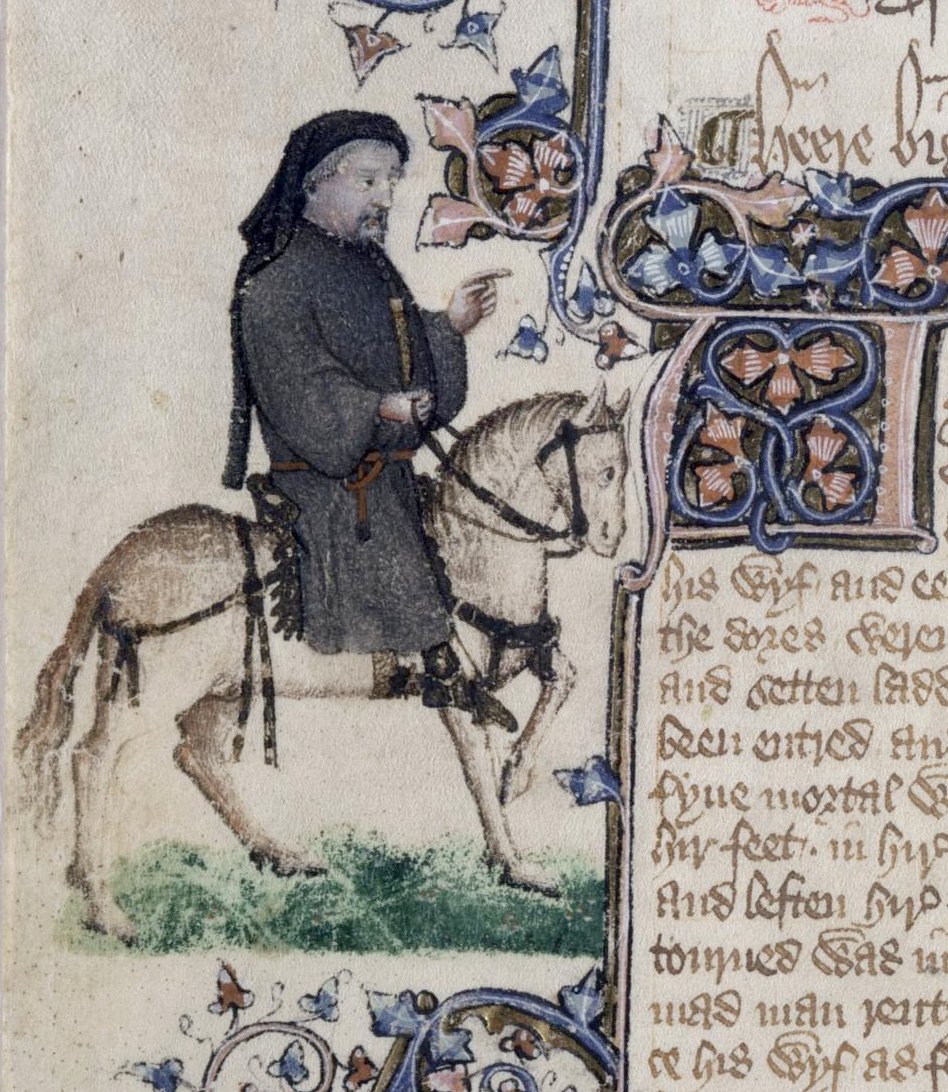
Riding along with Harry Bailey and his impromptu gathering of pilgrims on the way to Canterbury, we feel like neighbors among these thirteenth century characters, which should strike us as odd. That we understand them with a degree of intuition and a comfortable assurance that we ‘know how they feel’ is a testament to Chaucer, but also means that the age they inhabit is more like our own than that of the Volsungs, Julius Caesar, or Abraham. Perhaps these people, these companions on a garrulous vacation, are even more near to us now than they were in the late nineteenth century of our own lineage, they on an ascending path of virtuous relationships between the sexes, we on a riotous descent that threatens to undo what the renaissance bequeathed us. Their bawdy raunchiness is similar to the timbre of our popular cinema and television fables, yet they also have the amount of social consciousness that makes jokes about hypocrisy and veniality possible; we similarly cluck our tongues and reach for the popcorn. We are meeting at an intersection of public mores concerning marriage, theirs on an appointment with the dawning of Romantic marriage, ours leaving the romanticized notion of wedded bliss and moving toward hedonism. If we pay close attention, we will see that it is precisely where we don’t naturally understand their extended conversation on marriage that we are on different planes, and this helps us distinguish between what is merely common to humanity and what is particular about the times. The things that seem alien to us represent what has come before and therefore colors their preferences and obsessions while alienating our own. Good literature is familiar enough to allow us access, but strange enough to arouse our curiosity.
Much contemporary commentary around the marriage group of tales in Canterbury focuses on the inappropriateness of demands made on lovers within the marriage context. Since we are not actually allowed to speak among the pilgrims but only about them, it serves us to hear them out, both in their particulars and in their tendencies toward topics so that we may visit their time rather than forcibly pull them up from the historical depths onto the heaving decks of our own era. They, like benthic creatures, do not flourish in our rarified and breezy climes. Precisely what the context of marriage is to them cannot be the one we assume it is, but we may be able to deduce it should we carefully observe their habits and indulge a pilgrimage.
A pilgrimage implies a journey, and the figurative journey of conversation is matched by the pace of the pilgrims toward their shrine. Should we understand the conversation, generally the conversation dealing with men and women, and particularly and in its center the conversation on marriage as having a destination, a conclusion? How would we proceed?
The Marriage group begins with the Wife of Bath, is carried on guerrilla fashion with a counterattack by the Clerk, and after a confirmation by absurd example on the part of the Merchant, is born on the wings of love as it were, an encomium on Love itself by the Squire into the court of the Franklin. That this series forms a group is born out by the linking details in the various prologues stitching these responses together. More meaning may be grasped by considering these marriage tales to be pieces of a larger drama. Our task is to learn about a marital challenge, rebuttal and synthesis through this group, which will tell something of Chaucer’s opinion on the ideal state of marriage, and reveal our current attitudes in contrast.
The Wife of Bath begins her part with an extended prologue revealing what sounds like self-justification for serial polygamy. She has burned through five husbands, claiming to have fought for and obtained sovereignty over each man. The husband submits. This does not seem like a stable picture of the institution of marriage, more like a pyramid scheme or entrepreneurial estate planning.
The Clerk rebounds with a story about submissiveness personified in the case of Griselda. Impossible Griselda, who incites equal parts admiration and horror by her inhuman endurance, jangles our modern nerves particularly, painting an impossibly admirable picture. Rather than an example of a degenerating gambit through progressive power struggles, we see a situation of deferred glory through submission, with the end greater than the beginning, much suffering between.
The Franklin’s tale reveals a synthesis of these two concepts, sovereignty and submission, providence and liberty. We may read these as a constructive succession, and if this is the case, we may glean what Chaucer’s notion of a proper marriage was.
The progress of the pilgrims may extend as a paradigm for progress per se when we see the development of the marriage group as a series of replies.
That the Wife of Bath seems the most comprehensible of the three tales we are examining says much about us. On the basic level of humanity, her constant striving for mastery over her husbands using the bait first of sex, and later of pecuniary blandishments when her youthful charms have faded, seems like Dafoe’s Moll Flanders, Manon Lescaut of Abbe Prévost, La Dame aux camelias by Alexandre Dumas fils; any of a number of tales of the good hearted woman who lives by her wits and assets in a world of men bent on possessing a woman, culminating in modern movies like Pretty Woman. That her story reaches back toward allegories like Romance of the Rose is true, but the modernizing touch is the additional insight into her psychology that we are afforded by the extended anxiety revealed in her comically extended prologue. Her hashing and rehashing reminds us of a dog gnawing a bone.
Beyond the basic human condition displayed here is a detail that separates her story from the high medieval allegory of the Romance, however. While the allegory deals with unbounded ideas and the career of love at court, the W of B is recounting a surprisingly middle class adventure. Because of her social class, which seems very modern, she is capable of mobility. She moves at will from one marriage to another, exhausting the possibilities for gain and the life of each man in succession. She recalls:
469 But Lord Crist, whan that it remembreth me
The Wife of Bath’s Prologue
Upon my youthe and on my jolitee,
It tikleth me aboute myn herte roote —
Unto this day it dooth myn herte boote
That I have had my world as in my time.
This seems like retirement planning in the modern context. Remarkable that a character in a medieval context is seen living like a character in a serialized daytime television drama. Not so surprising is that every conflict in both settings is about power.
The W of B has one two concerns in marriage, the goal is pleasure, but it can only come from her liberty. This liberty means sovereignty, and in particular the sovereignty of herself, and by extension as she reveals in the tale itself the sovereignty of woman.
1258 …And Jesu Crist us sende
The Wife of Bath’s Prologue
Housbondes meeke, yonge, and fresshe abedde —
And grace t’overbide hem that we wedde.
And eek I praye Jesu shorte hir lives
That noght wol be governed by hir wives;
And olde and angry nigardes of dispense —
God sende hem soone a verray pestilence!
In this there is an origin story in Scripture; that of Adam and Eve. Adam tills the soil with the sweat of his brow because of the acquisitiveness of Eve, because of her desire for sovereignty. That the W of B turns this around in her tale, leading the errant Knight into paradisiacal wedded bliss by this path, seems only possible in a modernizing world, where the social position of a woman could include features like possession of choices, possession of wealth, leisure time and liberty. It seems that sensuous luxury is the goal of marriage in her eyes, and this possibility seems not strange to the body of pilgrims. Unsurprisingly, modern attitudes toward marriage begin and end here too.
That the tale of the Knight’s submission to the wife in an unquestioning way, the ceding of total sovereignty in order to gain domestic bliss could be entertained at this time reveals a progression in the career of marriage. Indeed, in our day who has not heard the bromide “happy wife, happy life”? Earthly sovereignty and liberty to enjoy life are in the grasp. This tale of the W of Bath, despite containing a point about possibility, contains a challenge to the very ideal of Bona Matrimonii. One could ask, “were there no children issued from these marriages?”
Theological doctrines concerning marriage were quite well established at the time of the Canterbury Tales. The purposes of marriage were summed up in “Fides, Proles, Sacramentum”. Of course the pilgrim in this set to dilate on theological ideals would be the Clerk. In point of fact, the Clerk has been directly challenged by the W of B since the treatment and overmastering of her husband Clerk are problematic in their apparent relegation of theology to the purely theoretic and impractical realm. We are further reminded of the W of B’s usurpation of the theologian’s role by her frequent method of exegesis, her specious arguments from scripture justifying here sensuality and mercantile sexuality.
The tale of Walter and Griselda presents us with a demonstration of the Church sanctioned understanding of marriage. Marriage in this time was not considered a mere license for sexual adventures, or a means of self-fulfillment. We will get a glimpse of this in parody with the Merchant’s Tale that follows what the Clerk has to offer. Griselda demonstrates classical virtues: Temperance in the way she uses her day, Wisdom in the way she deals with her husband’s subjects, Courage in the way she abides the perceived monstrosities committed by Walter against her own children, and ultimately against herself and their marriage. With all of this, however, the marriage is exactly what is preserved.
Regarding Fides, understood as fidelity and faithfulness, Walter consents to have his liberty curtailed by taking a wife. Faithfulness in the rendering of what was called ‘the debt’, what is owed to the marriage partner, is the granting of the ability to avoid licentiousness in sexuality, a preservation of humanity between the man and wife, and in this Griselda is faithful. We have no reason in the tale to think that Walter is unfaithful when the truth is revealed about his real actions and motives.
Regarding Proles, we see that children are indeed produced by the union of Walter and Griselda, and against all expectation, made to flourish spectacularly. Marriage is the means of filling the Kingdom of God with subjects, of glorifying God by causing the creation to expand.
Finally, in fulfillment of the Sacramentum, the Clerk’s tale reveals a meditation on the mysteries of the Faith. Walter’s perfect sovereignty, insisted upon by him, and Griselda’s total submission, willing and devotedly offered, are a mirror of the relationship of Christ and the Church, Christ coming toward incarnation by what seem like cruel and accidental steps in history, and Mary’s ‘let it be to me according to thy word ’. Additionally, the question of providence and freedom (that of sovereignty and liberty) are related in a Job-like fashion. The experience of providence can manifest as suffering, but providence’s final cause is glory. Griselda’s freely given devotion, chosen at every setback, demonstrates the final cause of liberty. These points play out in a stark and frightening way in the Clerk’s tale, and it feels the most alienating to us because it is inhuman. It makes deductive sense to us, however, because it is divine. Still, the upshot shows us that the refutation to the W of B’s life of sovereign pleasure seems unattainable and painful.
In the realm of attainment, we are answered and redirected in the person of the Franklin. Another character who seems more familiar to us, one we could converse with, the Franklin is another modernity aborning. A wealthy and accomplished man, despite his demurring regarding his elocution, he is what we would call noble. The idea that he is not actually noble in his time is interesting to us, since we assume meritocracy when we assume aristocracy. The Franklin can practically attain to something that the W of B alluded to in her story: Gentilesse. The Franklin in his prologue gives us a clue. He wishes his son could attain the degree of courtly gentility that the Squire has exhibited in his tale. The Franklin will add his example of gentilesse in marriage. From the Franklin’s tale:
682 “I have a sone, and, by the Trinitee,
The Franklin’s Tale
I hadde lever than twenty pound worth lond,
Thought it right now were fallen in myn hond,
He were a man of swich discrecioun
As that ye been!…
…
692 And he hath lever talken with a page
Than to commuine with any gentil wight
There he mighte lerne gentillesse aright.”
Gentilesse is a quality that the high born cannot merely inherit by their station. This quality is akin to Magnanimity, the Aristotelian quality of having breadth of soul. In the person of medieval gentility, a person is as generous as they are patient, as sovereign as they are obedient, they are not of the extreme in either appetites or asceticism. In some ways, descending from the practice of courtly love, where the knight would ‘court’ a married woman, bowing to her every wish, accepting every underserved chastisement, love was viewed as a discipline that could bring about this very gentilesse in the character of the practitioner. It is this extra quality that the Franklin will add to his tale in consideration of both the Wife of Bath and the Clerk, and why his tale can be seen as the resting place and conclusion of what has been a dialectic discussion dressed up in entertaining and enlightening stories.
Love is another idea that will receive fuller development, replying to the dilemma expressed by many in preceding tales: that love constrained is not sustained. When the freedom of the lover is disallowed, resentment replaces love and power becomes the topic of marital relationships. The relationship of Dorigen and Aurelius is foremost one of love. That this love seems almost illicit is due to the fact that its origin in this story seems to be that it occurred under color of courtly love. It is deemed inappropriate that a husband should dote on his wife, as this is a sign of thralldom in one who is supposed to be a sovereign, yet Aurelius doesn’t dote, he loves. Aurelius is magnanimous. Realizing that he prizes the love in return of Dorigen, he promises to be subject to her wishes, just as any knight in court toward his lady, remaining sovereign only in the public eye.
Dorigen does not dote either, but promises her love and observation of Aurelius’ public sovereignty. She proves her fidelity in setting an impossibly hard task to a young knight practicing the old ways of courtly love, seemingly in step with both virtue and the ways of gentilesse. By fulfilling her role as a lady of court, married to a powerful knight, she practices the virtuous paradigm. Of course the conflict that results from this promise and quest, its spoliation by wizardry, sets the stage for ultimate acts of magnanimity: who can give the most.
The most alien feature of the Franklin’s tale is perhaps the long absence of Aurelius as he pursues knightly virtue. However, it is precisely in this, and the expectant attention of Dorigen, indeed her anxiety for his safe return, that we see the impossibility of doting between the pair. That the two live out virtue in each other’s presence disallows the silly infatuation we see between other couples in Canterbury, notably the Miller and the Merchant. The pair are not even cohabiting for much of the narrative. Chaucer’s idea of ideal marriage is also one of theological import.
We note that the bride awaits the return of the bridegroom, all the while entangled in the affairs of court. We note that the bride makes foolish promises, prophesies things that turn up wrong, and is bedeviled by tricksters causing disrepute. The Bridegroom guards the fidelity and honor of the bride. Surprisingly in the Franklin’s tale, when Dorigen’s impossible task is seemingly accomplished and she must become the concubine of the aspiring knight, her husband is more concerned about her life and trustworthiness than her chastity. Once again the idea that marriage is a license for unbridled carnality and that it has nothing to do with virtue is refuted. Further, the idea that there is happiness in marriage itself, not just its effects, is affirmed as everyone who becomes involved in the marriage of Aurelius and Dorigen is blessed, each vying to outgive the other.
The conversation by story has moved beyond sovereignty. By recognizing that necessity exists, that pure liberty can never be other than an illusion, but that liberty is a necessary condition of love, the world of command and choice are joined. What was a struggle for power becomes a contest of love and gentilesse.
The Wife of Bath represents an impulse that has brought us to the place we are today in the twenty first century Western World. A land of opportunity prioritizes marriage as one of the goods that describe a happy life in our pursuit of happiness. Alongside financial and career attainment, to many a secular trinity, the unquenchable desires for sexual fulfillment – the lust of the flesh, the reputation in achievement – pride of life, and financial security – the lust of the eye, all seem to exhaust the aspirations of a good citizen. In Chaucer, we see the concept of his society and its root, that of marriage, in development. Marriage in Canterbury is moving toward a romantic apex, where not only the necessities of incarnation and dominion must be expressed by the union of men and women, but the dictates of happiness may flourish as people love each other for who they are, freely choosing to be in subjection to each other, just as Christ subjects himself to those he loves, all the while supremely sovereign. This situation did not exist in classical antiquity and needn’t have existed ever. That it could in the time of Chaucer represents an achievement, a solution to the dilemma of enmity between God and Man, between Man and Woman that colors our best understanding of modern love. That this achievement does not necessarily continue, we can plainly see.
Works Cited
Kitteridge, G.L. “Chaucer’s Discussion of Marriage.” Modern Philology Vol. 9, No. 4 (April, 1912): 435-467.
Lewis, C.S. The Allegory of Love. Cambridge: Cambridge University Press, 2017.
Mogan, Joseph J. “Chacer and the Bona Matrimonii.” The Chaucer Review Vol 4, No. 2 (Fall, 1969): 123-141.
Leave a Reply