Here I raise mine Ebenezer
Victrix causa diis placuit sed victa Cateni
Lucan, Pharsalia I.128
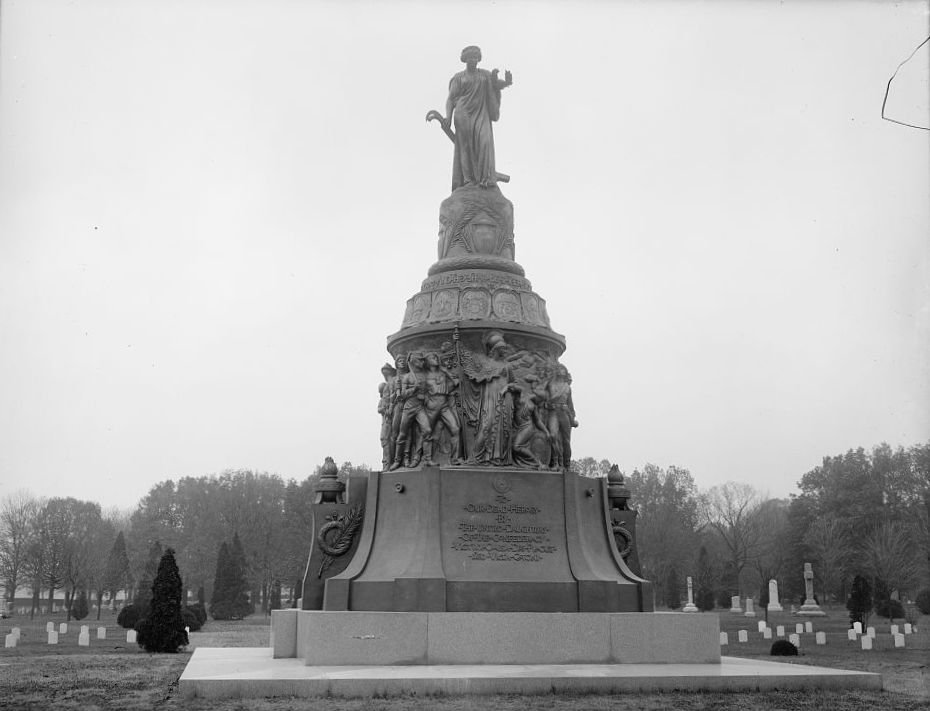
This quote from Lucan‘s Civil War is inscribed with irony and meta-historical flair on a forgotten monument in Arlington Cemetery. The inscription on the Confederate war memorial, placed in 1912, was within sight of the U.S. Army Band building and parking lot for my entire unwitting tenure with the Army Chorus. I used to park my car mere feet from the thing for years, my mind occupied with the droves of commuters in Northern Virginia which every year made the upstream struggle on interstate 95 more of an instinctual daily migration than a moment of conscious life. Perhaps my unaware and inauthentic life could be forgiven in that I was participating in a large organism known as the Federal Government, which moves more like a planet than a person.
Because of a recent trip with my students, I am not only aware of this statue and its precarious perch in our age, but liken it to a sentinel on the outpost of cogent history. It reminds, as in causing the observer to ‘un-forget’, which is the proper role of the monument. Because of its contrariness and attention to the duty of a sentinel, where it challenges those who approach for the password, it may suffer a fate one day like that of the poet whose words it now brandishes in the face of the intoxicated present. It is no secret among us that monuments to the past are abhorrent when they speak in any other way than to cheer on the powerful. However powerful people may be, it is wrong to think that the powerful are necessarily right, whether they are one tyrant or a hydra headed mob. It follows therefore, that it is not necessarily of the ethical good to deface the bastions of the past because of standing in the present — at least where real consideration of history is at stake. We may note that neither Julius Caesar, nor his successor Augustus were known for executing historians, but the lesser human alloys that were their successors did regularly.
Lucan (39–65 A.D.), being a Roman from the Iberian provinces, was a Pompey partisan, and in the confusing times in the aftermath of the Republic, he fell afoul of the Imperial present in his day. That present was curated by Nero (37–68 A.D.), the hilariously self regarding tyrant of the Roman Empire. Lucan’s voice of lamentation for the passing of the Republic and separation of powers, and his pointed criticism of the burning of Rome in 65 AD eventually earned him the Imperator’s ‘request’ that he commit suicide at the age of 25. A human monument, the historian, was cast aside because of his dissonance with the applause that Nero constantly sought. History is not a ship that is to be steered into the future, it is not even technically the past itself, it is the witness to the past. Nero never escaped a deluded childishness, and steered his ship, like the silly plot against his own mother, into a self annihilation. Tyrants do not like history, but are happy to deconstruct the past.
I have been shocked by history and monuments on several occasions. Once I was wandering around the grounds at Princeton, finding my way into a graveyard after hiking through the Revolutionary War battlefield there, and came to rest on a raised tombstone. Reading the inscription, I saw the name of Jonathan Edwards. I meditated on his relation to the Enlightenment and Evangelical Christianity, a topic to develop later. Earlier, on a trip to my childhood city of Sioux City, I visited my Grandfather’s grave and finding it, discovered that it overlooked my high school — Sioux City East. The realization that there was a direct line of sight between his monument and the place of my adolescent capering set me loose. As I followed the inference, I realized that I had been totally unaware of the impress of the past on my life. This is an essential property of the child. We call it naivety.
Now, in Arlington Cemetery, I was leading a group of children to this forgotten Confederate monument, bearing a message from another Confederate, Lucan. The monument itself was under assault. Our tour guide, a Kansan who had become a salaried federal historian, which gave our children a point of familiarity as they were Kansans, apologized for the presence of this statue. The image of southern blacks commiserating with Confederate soldiers was obviously incongruent with what is said to be true. He let on officially that memorials commemorate their own time of construction, not the time they memorialize. True enough, just as historians cannot escape the time of their own reflection, this man speaking included. Reading the Latin inscription however, which Washington official history guides never do, makes the monument impossible to dismiss so blithely. In fact, by muting the monument itself and its perspective, we create a straw man that may be easily torched.
In stupefying circularity, the ‘right side of history’ was blandly speaking in our midst as a commemorative reconstruction, proffered by one officially sanctioned by his own time and sanctified not by the stern admonition of the past, but by a blank congratulation of what has obviously come to pass — Washington D.C. He was actually being paid to say official perspectives over this tomb, and silencing the script itself. Is it possible for the Federal Government to have Official Historians in any other way than as paradigms of oxymoronic fallacy? An historian, at least as proposed by Thucydides, investigates the past. A propagandist and sophist apologizes for the present.
The inscription itself comments not only on the ‘lost cause’ of the confederacy, but on the personal experience of the historian versus the forces of the present. Loosely translated, Lucan observes that the cause of the victors (the Federals) pleased the gods, while the cause of the victims (losers of the Roman Civil War) pleased the family of Cato. The Catos were what would pass for conservatives in their day, standing athwart the tides of progress and shouting ‘stop’. The progress of the Romans in that time that they fought was away from participatory government and toward the largest administrative tax machine the world had ever seen. The gods, because this is the progress that came to pass, favored the Caesars, and Rome ceased to be any kind of democracy. Imperfect as that republican past was, it was a human construction and its preservation was seen as the human struggle against the inevitability of centralized power and tyranny, a feared destiny since before the founding of the Roman Republic, and clearly warned against by both Plato and Aristotle in one of their moments of agreement. The Catos of the day were fighting for the voice of the Roman Senate in particular, and representative democracy in general. How did the Caesars (or anyone in that day and place) gain the right to dictate the future? The Caesars may be said to have engaged in community organizing, gathering actual military power and force around issues like the right to own land and have access to Roman services and social protection for the many. This revelation is complicated.
The way of a fool is right in his own eyes, but he that hearkeneth unto counsel is wise
Proverbs 12:15
A real discussion of the monument as it stands without a gloss of present day narrative theory would actually be a service to those who live now, bestowed by those who came before. It is plain that the loss of history and the replacement by social narrative locks the people subjected to this sort of tour guided understanding into a childlike simplicity, which of course helps the project of consolidation, a modern slavery of the mind.
By the speaking of captive ‘history’, the knowledge of man is impoverished. By his impoverishment, he is enslaved. Slaves can never rule, and the Tyrant has no friends, only flatterers and slaves. Irony in iron, this civil war monument can speak for itself in its ‘ekphrasis’, or the reading out of its scenes, and in the very tongue of its ideological ancestor, Lucan. When the paid flatterer speaks over this monument to its time, he only serves to capture new slaves to serve the memory of dead ones.
Names and terms in this piece are gathered in the Glossary.
Leave a Reply